
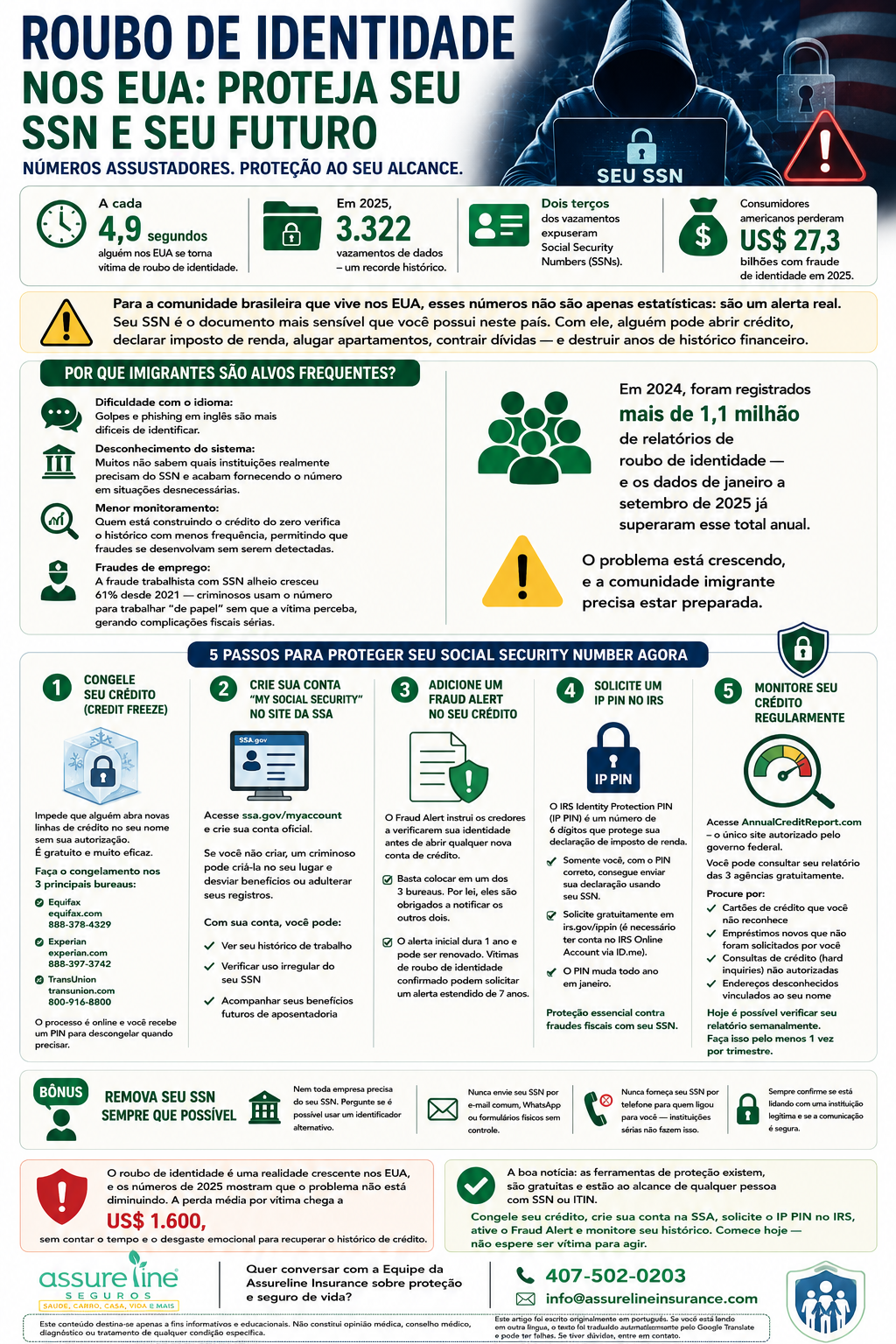
Your Social Security Number (SSN) is one of the most important identifiers you have in the United States. With it, criminals can open accounts, take out loans, file tax returns, and cause serious financial damage.
In this infographic, you will learn 5 free steps that can help protect your identity and reduce the risk of fraud.
Save this content and share it with other Brazilians living in the U.S. This information can help prevent many problems.
Every 4.9 seconds, someone in the United States becomes a victim of identity theft. By the time you finish reading this sentence, another person may have had their personal information compromised.
In 2025, there were 3,322 reported data breaches, the highest number ever recorded, and roughly two-thirds of them exposed Social Security numbers. Altogether, American consumers lost $27.3 billion to identity fraud that year.
These numbers are not just statistics. They are a warning.
Your Social Security number is one of the most sensitive pieces of personal information you have. With it, a criminal can open credit cards in your name, file a tax return using your identity, rent an apartment, take out loans, run up debt, and damage years of financial progress.
The good news is that you can take action. Some of the most effective protections are free, and you can put them in place today.
Why Your Social Security Number Is So Valuable to Criminals
Your SSN is tied to your financial life, tax records, work history, credit profile, and government benefits. That makes it a prime target for identity thieves.
Criminals use stolen SSNs in several ways. They may apply for credit, open bank accounts, file fraudulent tax returns, apply for jobs, rent housing, or use your information to pass background checks. In many cases, victims do not realize what happened until months later, when they are denied credit, receive unexpected tax notices, or find unfamiliar accounts on their credit report.
Identity theft is also becoming more sophisticated. Scammers use phishing emails, fake phone calls, text messages, data leaks, and stolen online credentials to gather enough information to impersonate real people. Once your SSN is exposed, the risk does not simply disappear. It can be misused years after the original breach.
That is why protecting your identity requires more than being careful. It requires putting safeguards in place before someone tries to use your information.
5 Steps to Protect Your Social Security Number Now
Step 1 — Freeze Your Credit
A credit freeze is one of the strongest ways to protect yourself, and it is completely free.
When your credit is frozen, no one can open a new credit card, loan, or financing account in your name unless you temporarily lift the freeze first. That includes you. If a criminal tries to use your SSN to apply for credit, the request will usually be blocked because the lender cannot access your credit file.
Freeze your credit with all three major credit bureaus:
- Equifax: equifax.com | 888-378-4329
- Experian: experian.com | 888-397-3742
- TransUnion: transunion.com | 800-916-8800
The process can usually be completed online in a few minutes. You will be able to temporarily unfreeze your credit when you need to apply for a legitimate loan, credit card, apartment, or other service.
Step 2 — Create Your “my Social Security” Account
Go to ssa.gov/myaccount and create your official my Social Security account with the Social Security Administration.
This is an important step because if you do not create your own account, someone else may try to create one using your personal information. A fraudulent account could be used to access sensitive records, interfere with future benefits, or manipulate information connected to your Social Security profile.
Your account also lets you review your earnings history, confirm that your work record looks accurate, and monitor information related to future retirement or disability benefits.
Step 3 — Add a Fraud Alert to Your Credit File
A fraud alert tells lenders and creditors to take extra steps to verify your identity before opening a new account in your name.
Unlike a credit freeze, a fraud alert does not block access to your credit file. Instead, it adds another layer of verification. This can help prevent someone from opening credit using your information.
You only need to place the alert with one of the three major credit bureaus. By law, that bureau must notify the other two.
An initial fraud alert lasts one year and can be renewed. If you are already a confirmed victim of identity theft, you may qualify for an extended fraud alert that lasts seven years.
Step 4 — Request an IRS Identity Protection PIN
The IRS Identity Protection PIN, often called an IP PIN, is a six-digit number that helps protect your federal tax return.
Once you have an IP PIN, the IRS will require that number when a tax return is filed using your Social Security number. If someone tries to file a return without the correct PIN, the return will be rejected.
You can request an IP PIN for free at irs.gov/ippin. The process is completed online through an IRS Online Account and identity verification. The PIN changes every year, usually in January.
This is one of the most powerful identity protection tools available, especially because tax-related identity theft can be difficult and time-consuming to fix.
Step 5 — Monitor Your Credit Reports Regularly
Visit AnnualCreditReport.com, the only federally authorized website for free credit reports from the three major credit bureaus.
Review your reports from Equifax, Experian, and TransUnion. Look carefully for anything that does not belong to you, including:
- Credit cards you do not recognize
- Loans you did not apply for
- Unauthorized hard inquiries
- Addresses you have never used
- Collection accounts that are unfamiliar
- Names, employers, or personal details that are incorrect
You can currently check your credit reports weekly for free. At minimum, review them once every three months. Catching fraud early can make the recovery process much easier.
Bonus Step — Do Not Give Out Your SSN Unless It Is Truly Necessary
Many businesses, medical offices, schools, landlords, and service providers ask for a Social Security number as a routine part of paperwork. But they do not always need it.
Before providing your SSN, ask whether it is legally required or whether another identifier can be used instead. In many situations, you may be able to leave the field blank or provide an alternative form of identification.
When you do need to provide your SSN, make sure you are dealing with a legitimate organization and that the communication method is secure.
Never send your SSN by regular email, text message, WhatsApp, or through unsecured forms. Do not write it on paperwork that will be passed around without proper handling. And never give your SSN over the phone to someone who called you unexpectedly. Legitimate institutions will not pressure you into sharing sensitive information that way.
Protect Your Identity Before There Is a Problem
Identity theft is a growing problem in the United States, and recent data shows that the risk is not slowing down. The average loss per victim can reach $1,600, not including the time, stress, and paperwork required to repair damaged credit and restore financial accounts.
The strongest approach is prevention.
Freeze your credit. Create your my Social Security account. Request an IRS IP PIN. Add a fraud alert. Monitor your credit reports. Limit where and how you share your Social Security number.
These steps are free, practical, and available now.
Do not wait until your identity has already been stolen. Protect your Social Security number today.